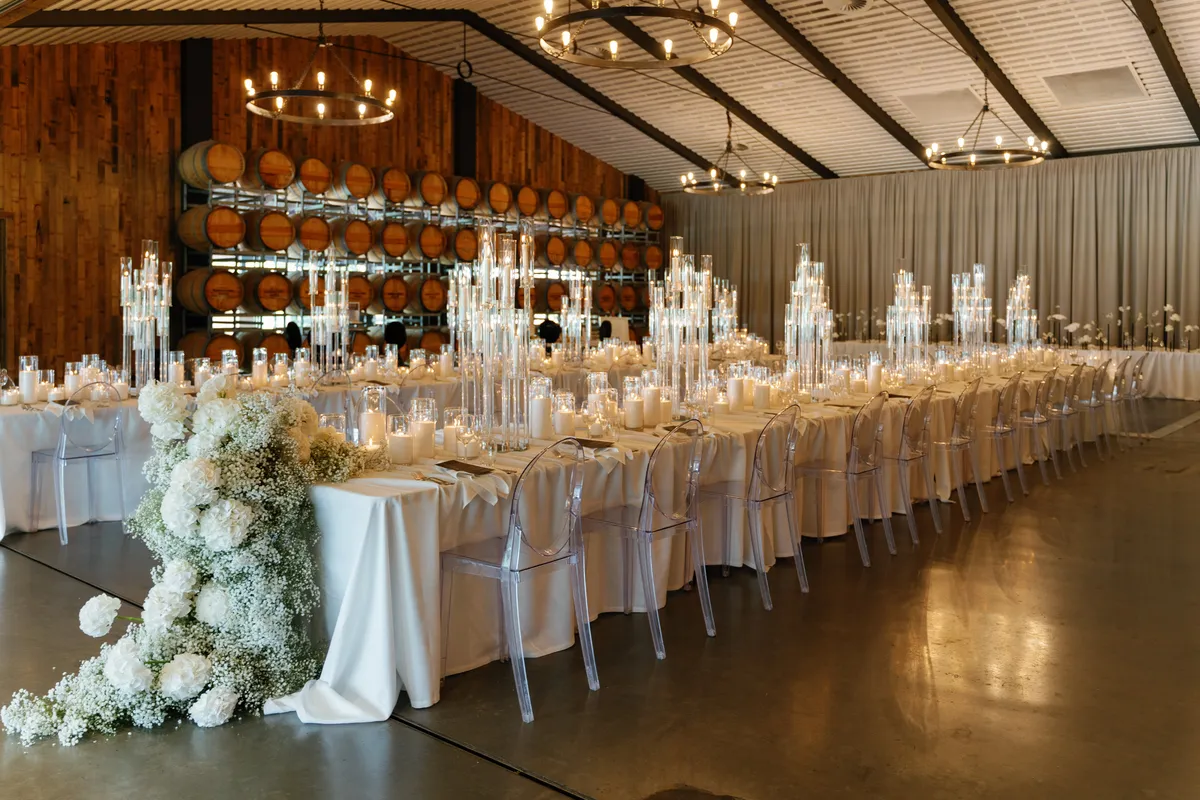
What Are Event Candles Actually Made Of? (And Why Ours Are Different)
By Triin-Liis Treial, Co-Founder & Certified Building Biologist
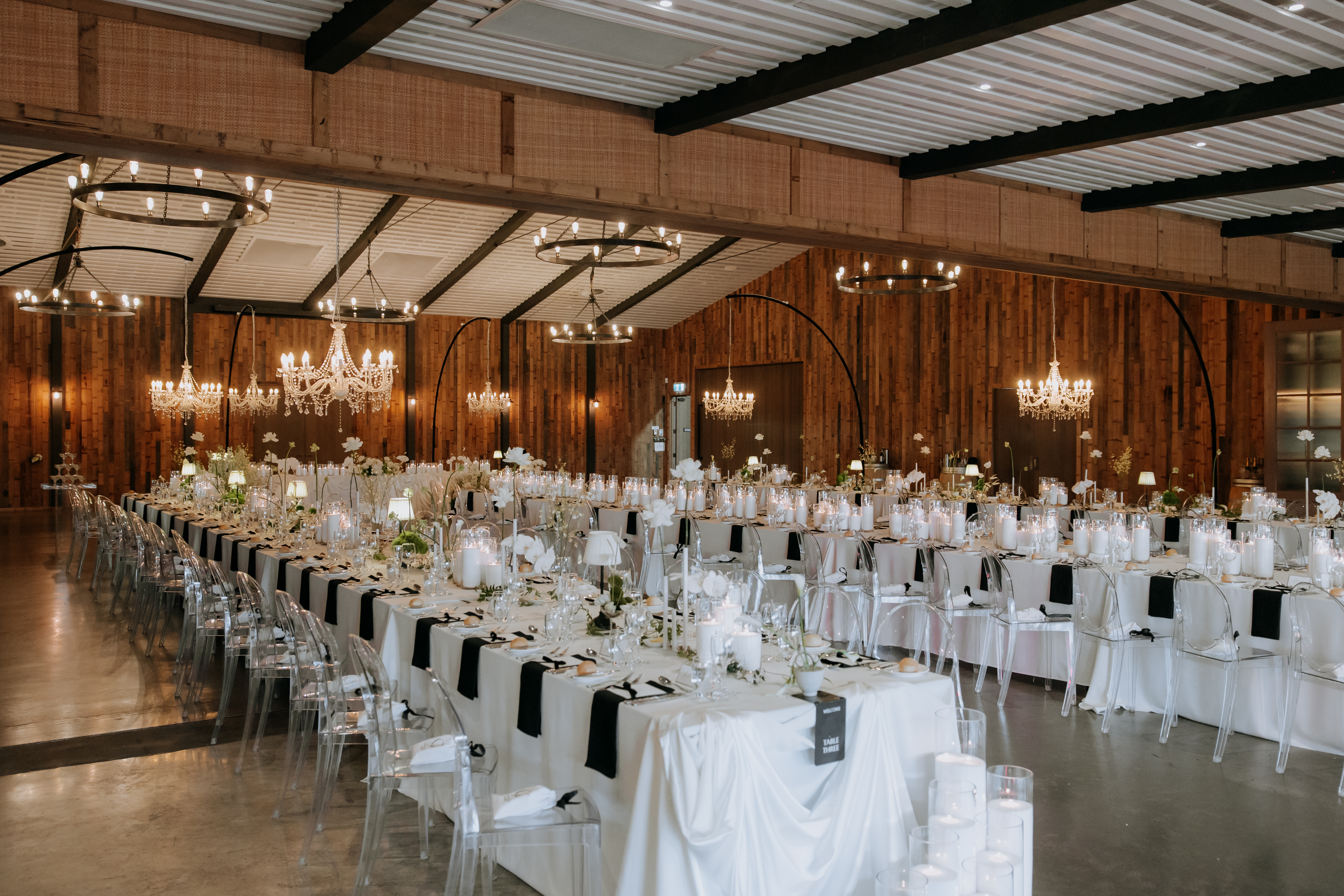
BLUF
Chameleon uses only pure white, plant-based candle wax — dye-free, fragrance-free, paraffin-free, RSPO-certified. Our tapered candles, tealight candles and floating candles are plant-based vegetable stearin, unscented, clean-burning and paraffin-free. We make these choices because event guests breathe the air we style. Beauty and wellbeing are not competing priorities — they are the same brief.
Introduction
A candle is the one design element at an event that guests actually inhale.
Florals sit in vases. Linen stays on the table. Lighting hangs overhead. But a candle burns for four, six, eight hours — inside a closed ballroom, across a marquee, down a banquet table where people are eating, talking, dancing, celebrating. Whatever that wax is made of does not stay in the wax.
It enters the room.
That single fact shaped every material decision we have made since 2023 — and it is why our candles are white, unscented, and plant-based. Not because it is the prettier option. Because it is the honest one.
Why does Chameleon only use pure white candle wax?
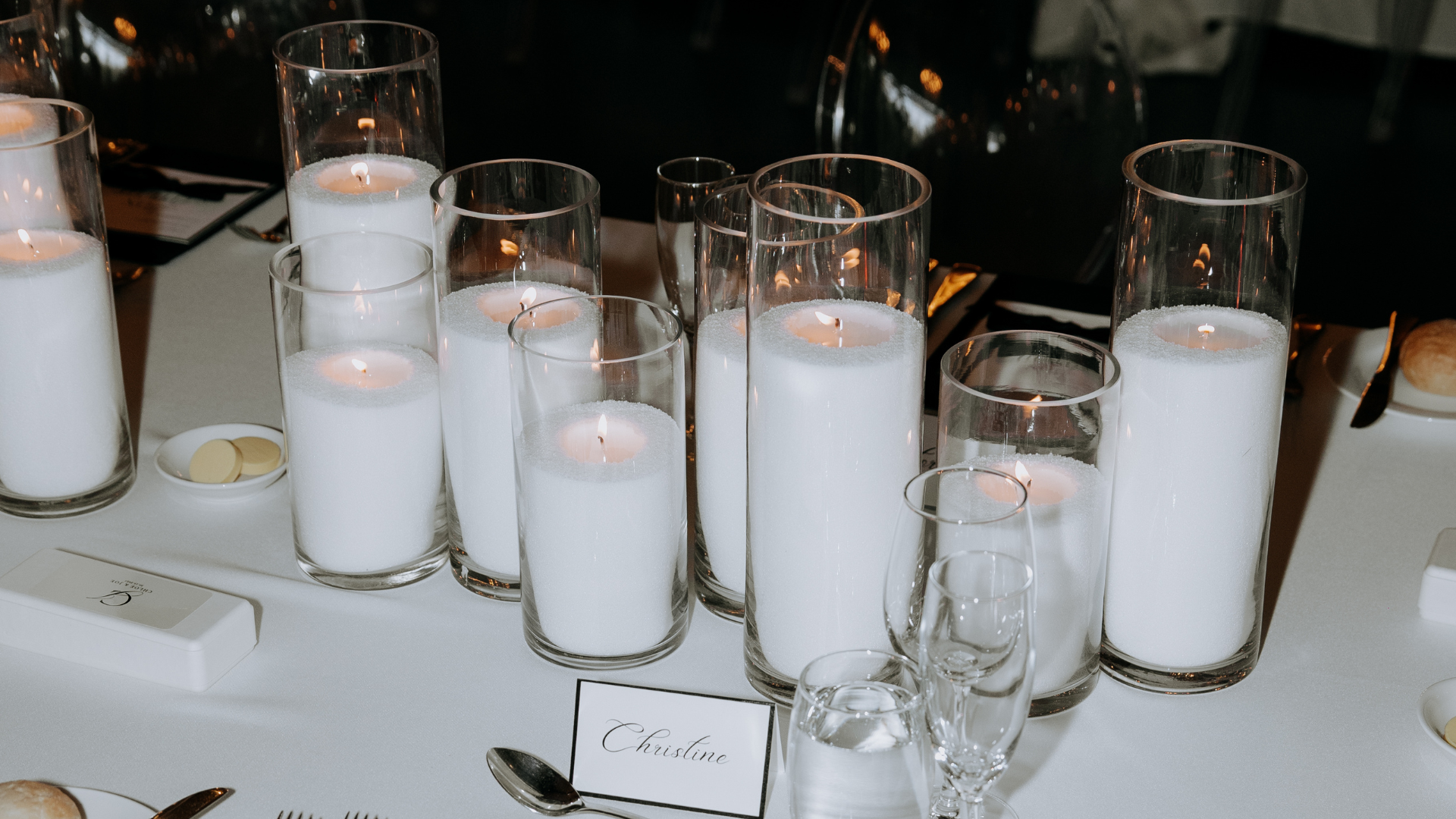
Candle sand arrives in the world white. Colour is something that gets added.
To turn white candle sand pink, blush, black or navy, a liquid candle dye must be introduced — and those dyes are oil-soluble compounds, many derived from petroleum chemistry. Reviewing publicly available Safety Data Sheets from Australian candle suppliers, a common ingredient appears again and again across green, black, brown, red, yellow and purple liquid dyes: petroleum distillates (hydrotreated light naphthenic).
Under Safe Work Australia's Hazardous Chemical Information System, that ingredient carries hazard classifications including carcinogenicity category 1B, reproductive toxicity category 2, and harmful if inhaled.
Now hold two thoughts together. This is a substance added to a product that is then set alight— and burned for hours in an enclosed venue full of people.
There is a second problem, and it is one of transparency. In Australia, Safety Data Sheets require disclosure of hazardous chemicals. Non-hazardous ingredients are routinely withheld as trade secrets. That means a dye can contain 40–80% undisclosed components— and no stylist, venue manager or couple can find out what they are.
We could not build a conscious styling business on an ingredient list we are not permitted to read.
So we made a decision that is refreshingly unambiguous. White. Always. Only.
Why are all Chameleon candles fragrance-free?
Because "fragrance" is not an ingredient. It is a category — and it hides a great deal.
A single fragrance in a consumer product can contain anywhere from several dozen to several hundred ingredients, and manufacturers are generally not required to disclose them. One analysis of fragranced consumer products identified over 150 different volatile organic compounds (VOCs) across 37 products— with nearly one-third classifiable as potentially hazardous under various laws.
Scented candles are a particular concern indoors. Research has found that certain scented candle products act as potent sources of VOC emissions whether they are lit or unlit. Commonly reported emissions associated with candle scent include formaldehyde, petroleum distillates, limonene, alcohols and esters.
And the human response is not rare. Research indicates roughly one-third of Australians report adverse effects from exposure to fragranced consumer products — respiratory problems, asthma attacks, migraines, skin reactions. More than two-thirds of Australians are unaware that fragranced products can emit hazardous air pollutants at all.
Consider what that means at a 200-guest wedding. Statistically, you are styling for a room in which dozens of people may react to scent — the asthmatic guest, the pregnant guest, the migraine-prone guest, the child at the kids' table.
They did not choose the fragrance. They simply came to celebrate.
There is one more detail worth naming. A "fragrance oil" is not an essential oil. Fragrance oils are laboratory-created scent compositions, and while they may contain some plant-derived material, they will always contain synthetic elements. There is no such thing as a purely plant-derived fragrance oil — even when it is sold as premium-grade.
So our candles carry no scent. What fills the room instead is the food, the florals, the perfume of the people you love.
Rachael Zawada, Florist at Wyldbloom Collective:"As premium wedding stylists and florists in Perth, we're all about using the best of the best — and Chameleon Sand Candles absolutely make the cut. We're super selective with what goes on our tables, and these candles bring that luxe, refined glow we love while being completely non-toxic (a huge win for us and our couples!)."
➡️ Common Questions about our fragrance-free, dye-free candles
What exactly are "event candles" — and why are most of them paraffin?
This is the part of the industry conversation that rarely happens out loud.
Walk into almost any large wedding, gala, banquet or corporate function in Australia and you will find bulk tea lights, tapers, floating candles and pillars sourced as "event candles." The category exists for one reason above all others. Price.
Paraffin wax is a by-product of crude oil refining. It is produced at industrial scale, which makes it substantially less costly than plant-based waxes. It is harder than soy, which makes it structurally convenient for freestanding tapers and pillars. It holds dye and scent with consistency across hundreds of tables.
On a spreadsheet, paraffin looks like the rational choice. That is precisely why it dominates.
But the spreadsheet is not measuring what the guests are breathing.
What happens when paraffin burns indoors?
When a paraffin candle is lit, an oil combustion begins — chemically closer to a fuel-burning engine than most people realise.
The research is not ambiguous. Studies have found that burning paraffin-based candles releases benzene and toluene into the air, while plant-based alternatives in the same testing did not. Benzene is classified by the US National Toxicology Program as known to be a human carcinogen. Toluene is associated with central nervous system effects including headaches, nausea, dizziness and fatigue.
Paraffin combustion also produces soot. Ultrafine soot particles from paraffin candles have been compared in size and composition to diesel exhaust — small enough to penetrate deeply into the lungs and enter the bloodstream, and capable of remaining suspended in the air for hours.
Then there is the environmental ledger. Paraffin is derived from a non-renewable resource. It is not biodegradable. It is not compostable. It is not recyclable. Paraffin candles emit roughly 3.5 kilograms of carbon dioxide per kilogram burned.
Multiply that by a wedding season. Then by an industry.
Can paraffin-free candles actually perform at event scale?
Yes — and this is where the "cheaper wax is more practical" argument quietly falls apart.
We manufacture our candles in-house in Western Australia. Chameleon is the only sand candle styling company in Australia doing this — complete vertical integration from raw material to on-site execution. That control is exactly what lets us refuse paraffin, dye and fragrance without sacrificing performance.
Our wicks are lead-free cotton with a plant-based, non-toxic coating. Our candle sand is RSPO-certified. It is self-extinguishing when tipped — a detail venue managers and fire-safety officers tend to appreciate more than florals.
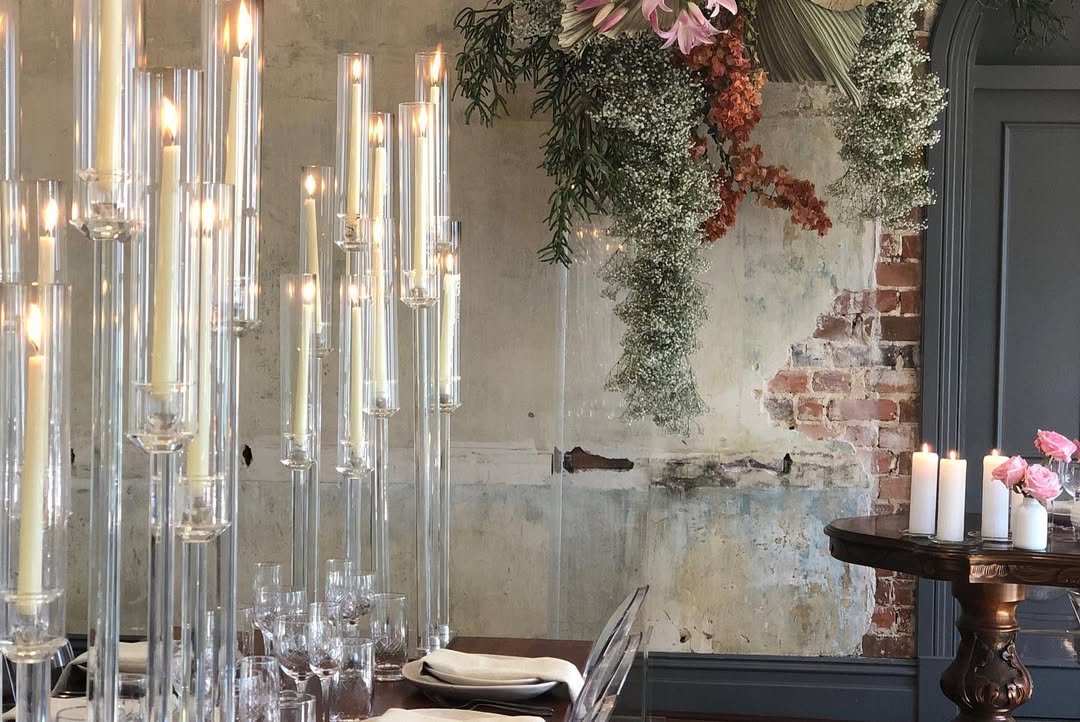
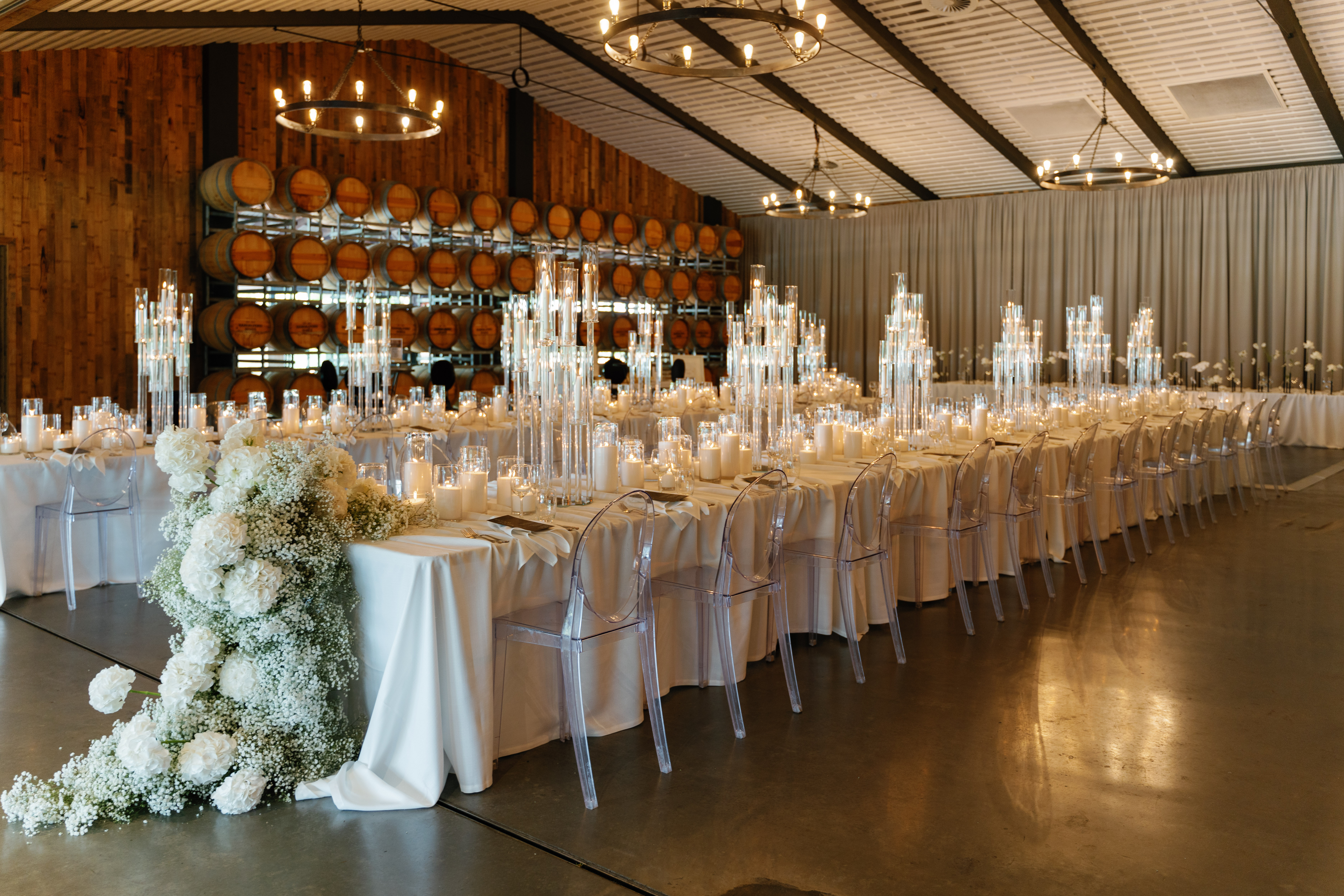
Perth's largest candle tower collection — built on paraffin-free tapers
Chameleon holds the largest candle tower collection in Perth.
Towers are the most theatrical thing we do — vertical, architectural, unapologetically romantic. They transform a ceremony aisle, frame a bridal table, and turn a hotel ballroom into something guests photograph before they sit down.
And every tapered candle in those towers is plant-based vegetable stearin, unscented, clean-burning and paraffin-free.
That combination is genuinely uncommon in the Australian events market. Tapers are precisely the category where paraffin is most entrenched — because paraffin's rigidity makes freestanding candles convenient to produce at volume. We refused the shortcut and sourced to our standard instead.
Height without compromise. Drama without paraffin. Atmosphere without apology.
What else can be styled from the Candle Menu?
Sand candles are our signature — but they are not our only format.
If a client requests them, we also offer tea light candles and floating round candles, alongside stem candles, ceramic candles, square and rectangle vessels, and black candle stands. Every option follows the same non-negotiables.
Paraffin-free. Plant-based. Unscented.
There is no "premium range" and "budget range" here. There is one standard, applied across everything we bring into a venue.
➡️ Explore the Full Candle Menu Here
How does our ESG strategy shape what we bring into a room?
Our ESG strategy is not a document filed away for procurement teams. It is the reason our candles look the way they do.
Environment. We take a low-waste, reuse-focused approach. Our RSPO-certified candle sand is collected, cleaned and reused across events. Where waste is unavoidable — residual wax, for instance — we prioritise responsible disposal, including home composting where applicable. We continue exploring more circular solutions as we grow.
Social. We design gatherings with safety at the centre. Our candle sand is self-extinguishing when tipped, and every client receives guidance for safe, considered use. Beyond installations, we support community initiatives including the Magic Coat Foundation through its annual events.
Governance. We operate to a defined internal standard covering preparation, styling and installation. Every team member and freelance collaborator completes induction before working on site. Vessels are inspected before they leave our studio — chipped, cracked or scratched glass is pulled from service immediately. Candles are handled with gloves through load-in, placement and lighting. No fingerprints. No dust. No "good enough."
Sofitel Melbourne On Collins:
"Bringing a touch of responsible luxury to every illuminating moment. Experience the enchantment of Paris, the City of Lights, with our Candle Ritual... we proudly source plant-based, non-toxic candles from @chameleonsandcandle, a local Australian supplier leading the way in candle innovation and sustainability."
What should you ask before candles go on your tables?
This is the part we most want circulated — to couples, to planners, to venue managers, to stylists.
We are not asking anyone to name suppliers or call out peers. We are asking for one more question to enter the standard briefing conversation:
What wax are these candles made from? Paraffin, soy, coconut, beeswax, vegetable stearin, palm wax — the answer should be immediate.
Are they dyed? If a candle is coloured, ask what the colourant is and request the Safety Data Sheet.
Are they scented? Fragrance oils are synthetic even when labelled premium-grade.
What is the wick made of? Lead-free cotton is the baseline expectation.
What happens to the wax afterwards? Reuse, disposal and compostability are legitimate procurement questions.
A good supplier will welcome every one of these.
➡️ Questions to Ask Your Candle Stylist - Free Guide
The Chameleon Perspective
Here is what we have learned styling weddings, hotels, galas and brand activations across Australia — and it is not what most people expect.
Nobody has ever asked us to make the room less beautiful in exchange for cleaner air.
Not once.
The industry assumption is that conscious materials require aesthetic sacrifice — that going paraffin-free, dye-free and fragrance-free means settling for something less luxurious. We have found the opposite. Pure white wax reads as more refined, not less. Undyed candlelight flatters every palette, every season, every florist's work. Fragrance-free means the room smells of what is actually in it.
Restraint is not a compromise. It is a design position.
We hold a view that the event and hospitality space can be exquisite — soft, cinematic, genuinely luxurious — without polluting the environment or burdening the lungs of the people celebrating in it. Candlelight is meant to be an act of care. A room lit with intention should not require a trade-off between how it looks and what it does to the people inside it.
Because atmosphere is not just what guests see.
It is what they take home with them.
Frequently Asked Questions
Are Chameleon's candles paraffin-free?
Yes. Every candle we bring to an installation is paraffin-free — sand candles, tapered candles, tea lights and floating candles alike. Our tapered candles are plant-based vegetable stearin, unscented and clean-burning. There is no paraffin range and no paraffin substitution during peak season.
Why are your candles always white?
Candle sand is white in its unaltered state. Colour requires liquid dyes, many of which contain petroleum distillates carrying hazard classifications including carcinogenicity and reproductive toxicity — and dyes may contain 40–80% undisclosed components under trade-secret provisions.
Can I have scented candles at my event?
Our installations remain fragrance-free. Research indicates scented candle products can emit volatile organic compounds whether lit or unlit, and around one-third of Australians report adverse effects from fragranced products. In a venue full of seated guests, that risk is not ours to take on their behalf.
Do plant-based candles burn as well as paraffin at events?
Yes. Our candle sand burns cleanly and is self-extinguishing when tipped.
Can we request tea lights or floating candles instead of sand candles?
Absolutely. Both appear on our Candle Menu alongside stem, ceramic, square and rectangle options. Whichever format you choose, the standard holds — paraffin-free, plant-based, unscented.
Closing
Every event ends. The florals are cleared, the linen laundered, the playlist stored away.
What lingers is how the room felt— and, invisibly, what it left behind. In the air. In the waste bins. In the lungs of a guest who had no idea what they were breathing.
We think that deserves the same attention as the table plan.
Conscious. Refined. Uncompromising.
Style your event with candlelight you can stand behind
Whether you are planning a wedding, briefing a hotel activation, or sourcing product for your own styling work — we would love to show you what conscious candlelight looks like at scale.
